


Semantic Context vs. Relationship Context in Enterprise Text-to-SQL


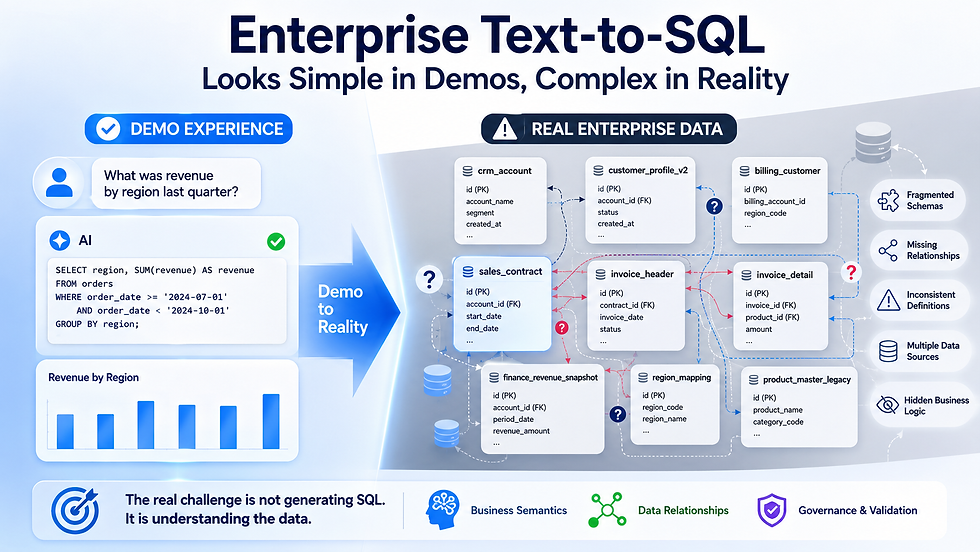
Enterprise Text-to-SQL is often described as a natural language problem.
A user asks a question. The system understands the intent. The AI writes SQL. The answer comes back as a table, chart, or explanation.
That description is simple.
The real problem is not.
In production enterprise environments, reliable Text-to-SQL depends on two different types of context:
Semantic context — what business terms mean.
Relationship context — how enterprise data actually connects.
Most teams understand the first one earlier than the second one.
They invest in business terms, metric definitions, dimensions, and semantic layers. That is necessary. Without semantic governance, AI systems cannot know what “revenue,” “active customer,” “gross margin,” or “inventory balance” should mean.
But semantic context alone is not enough.
Even if an AI system understands the meaning of a business question, it still needs to know which tables to use, how those tables connect, which join path is safe, which relationship is trusted, and when the data structure is too ambiguous to answer confidently.
That is relationship context.
For enterprise AI analytics, both are required.
[Image 1: Hero Image]
Image Placement:Place this image directly below the introduction.
Image Caption:Reliable enterprise Text-to-SQL requires both business meaning and trusted data relationships.
Image Alt Text:Semantic context and relationship context working together for reliable enterprise Text-to-SQL
Suggested Image Description:A clean enterprise architecture diagram showing business semantic context on the top layer, data relationship context on the bottom layer, and an AI query engine in the center using both layers to generate trusted SQL.
What Is Semantic Context?
Semantic context explains the business meaning behind data.
It helps an AI system understand how business users talk about the organization, and how those business concepts map to structured data.
For example, a business user may ask:
What was revenue by customer segment last quarter?
To answer this correctly, the system must understand:
what “revenue” means
which metric definition is approved
which date field defines “last quarter”
what “customer segment” refers to
whether cancelled, refunded, or draft transactions should be excluded
whether the answer should follow finance, sales, or operational reporting logic
This is the role of semantic context.
It turns business language into governed meaning.
A strong semantic layer usually includes:
business terms
approved metrics
dimensions
synonyms
calculation rules
filters
ownership
versions
governance status
Without semantic context, the AI may generate SQL that is syntactically valid but conceptually wrong.
For example, the model may use order_amount when finance expects recognized_revenue. It may use created_date when the business expects invoice_date. It may group by sales region when leadership expects billing region.
These are not SQL syntax errors.
They are business meaning errors.
That is why semantic governance matters.
[Image 2: Semantic Context Layer]
Image Placement:Place this image after the section “What Is Semantic Context?”
Image Caption:Semantic context defines business terms, metrics, dimensions, and governed definitions.
Image Alt Text:Business semantic context layer for enterprise Text-to-SQL and AI analytics
Suggested Image Description:A layered diagram showing business terms, metrics, dimensions, synonyms, definitions, calculation rules, and governance status feeding into an AI query engine.

What Is Relationship Context?
Relationship context explains how data is connected.
It tells the system which tables are related, which fields can be used as join keys, which paths are preferred, and which relationships are risky or ambiguous.
In real enterprise environments, this is often the hidden layer behind successful analysis.
A business question may sound simple:
What was revenue by customer segment last quarter?
But the data may be spread across many tables:
customers
crm_accounts
customer_profiles
sales_contracts
invoices
invoice_details
revenue_snapshots
product_master
region_mapping
segment_history
The AI must not only understand the business meaning of “revenue” and “customer segment.” It must also understand how revenue data connects to customer data, how customer data connects to segment data, and which path avoids duplication or incorrect aggregation.
A technically possible join is not always an analytically correct join.
This is where many Text-to-SQL systems fail.
They can see table names and column names, but they do not know which relationships are trusted.
Relationship context includes:
table-to-table relationships
field-to-field relationships
primary key and foreign key candidates
inclusion relationships
co-occurrence relationships
bridge tables
join paths
relationship strength
relationship confidence
cross-source links
row-grain compatibility
This context helps the AI avoid dangerous assumptions.
For example, joining invoice headers directly to customer profiles may work in one case but duplicate rows in another. Joining by customer name may look plausible but fail when names are inconsistent. Joining transaction-level data to snapshot-level data may produce results that are mathematically incorrect.
The model may still write SQL.
But without relationship context, it may write the wrong SQL.
[Image 3: Relationship Context Layer]
Image Placement:Place this image after the section “What Is Relationship Context?”
Image Caption:Relationship context tells AI how enterprise tables, fields, and join paths are connected.
Image Alt Text:Data relationship context showing table relationships, join paths and cross-source links for Text-to-SQL
Suggested Image Description:A technical data graph showing multiple enterprise tables, relationship lines, join path candidates, confidence indicators, and highlighted trusted paths.

Why Semantic Context Alone Is Not Enough
A semantic layer can tell the AI that “revenue” means recognized revenue.
That is valuable.
But the system still has to answer practical data questions:
Which table contains recognized revenue?
Which table contains customer segment?
How does revenue connect to customer?
Is the relationship direct or indirect?
Which join key should be used?
Does the join duplicate rows?
Is the customer segment current or historical?
Should the query use the latest customer profile or the segment at transaction time?
These are not only semantic questions.
They are structural questions.
A semantic layer defines what the business wants. Relationship context defines how the data can produce it safely.
If the semantic layer says:
Revenue = recognized revenue amount
that still does not automatically tell the system how to join revenue_snapshot to customer_profile, or whether it should go through invoice_header, sales_contract, or a mapping table.
This is why enterprise Text-to-SQL needs both layers.
Semantic context answers:
What does the user mean?
Relationship context answers:
How can the system retrieve it correctly?
Both are necessary for trusted AI analytics.
A Simple Example
Imagine a user asks:
Show revenue by customer segment for last quarter.
A semantic-only system may understand:
revenue = recognized revenue
customer segment = customer profile segment
last quarter = date filter
It may then generate a query using tables that appear relevant.
But if the data relationships are not clear, several problems can happen.
Problem 1: The wrong customer table is selected
The database may contain:
customer
crm_account
billing_customer
customer_profile
customer_snapshot
Each table may be valid for a different business purpose.
Without relationship context, the model may choose the table with the most obvious name rather than the authoritative table.
Problem 2: The wrong join path is used
Revenue may connect to customers through invoices, contracts, accounts, or billing records.
A direct join may seem possible but may not reflect the approved reporting path.
Without trusted join path information, the model may generate SQL that returns inflated or incomplete results.
Problem 3: The data grain is mismatched
Revenue may exist at invoice-detail level. Customer segment may exist at account level. Region may exist at billing-account level.
If the model joins these tables without understanding grain, it may duplicate revenue across multiple rows.
The SQL runs.
The result is wrong.
Problem 4: Historical meaning is lost
Customer segment may change over time.
If the user asks for last quarter’s revenue by segment, should the system use the customer’s current segment or the segment at the time of the transaction?
That requires more than table names.
It requires governed context.
Relationship Context Makes AI More Careful
A relationship-aware Text-to-SQL system does not simply ask the model to infer everything from schema names.
Instead, it provides the model with structured relationship evidence before SQL generation.
For example, before generating SQL, the system should be able to identify:
candidate tables
relevant fields
known relationships
possible join paths
preferred join path
risky relationships
missing relationships
ambiguity requiring clarification
This allows the system to behave more carefully.
If the relationship is clear, it can generate SQL.
If multiple paths exist, it can select the governed path or ask for clarification.
If no trusted path exists, it can warn the user instead of pretending to know.
That is a major difference.
Enterprise users do not only need fast answers.
They need trustworthy answers.
The Better Workflow
A basic Text-to-SQL workflow looks like this:
User question → LLM → SQL → AnswerThis workflow is simple, but it puts too much responsibility on the model.
A more reliable enterprise workflow should look like this:
User question
→ Intent understanding
→ Semantic mapping
→ Metadata retrieval
→ Relationship discovery
→ Join path selection
→ SQL generation
→ Validation
→ Execution
→ Explanation
In this workflow, the language model is still important.
But it is not acting alone.
It is supported by governed semantic context and trusted relationship context.
This makes the system more explainable, more auditable, and more suitable for real enterprise use.
[Image 4: Combined Enterprise Text-to-SQL Workflow]
Image Placement:Place this image after the section “The Better Workflow.”
Image Caption:Production-grade Text-to-SQL is a governed data workflow, not a single prompt.
Image Alt Text:Enterprise Text-to-SQL workflow combining semantic mapping, relationship discovery, join path selection and SQL validation
Suggested Image Description:A horizontal workflow diagram from user question to intent understanding, semantic mapping, metadata retrieval, relationship discovery, join path selection, SQL generation, validation, execution, and explanation.

Why This Matters for Enterprise AI Analytics
Enterprise AI analytics is not just about making SQL easier to write.
It is about making structured data easier to use safely.
That requires three things working together.
First, business users need a natural language interface that matches how they ask questions.
Second, data teams need semantic governance so business terms, metrics, and definitions stay consistent.
Third, the system needs data relationship intelligence so it can understand how tables and fields connect across complex enterprise environments.
Without semantic context, the system may misunderstand the question.
Without relationship context, the system may retrieve the data incorrectly.
Without validation, the system may return a confident answer that no one should trust.
This is why enterprise Text-to-SQL should not be treated as a prompt engineering project.
It should be treated as a governed data infrastructure problem.
What Enterprise Teams Should Evaluate
When evaluating an enterprise Text-to-SQL or AI analytics platform, teams should ask more than:
Can it generate SQL?
They should ask:
Can it manage business terms and metric definitions?
Can it map business language to governed data structures?
Can it discover table and field relationships automatically?
Can it recommend trusted join paths?
Can it identify relationship ambiguity?
Can it validate generated SQL before execution?
Can it explain which tables, fields, and relationships were used?
Can it support multiple data sources?
Can governance teams review and improve the knowledge base?
Can the system get better as users provide feedback?
The best enterprise AI analytics systems will not be the ones that only produce SQL quickly.
They will be the ones that produce SQL with the right context.
How Arisyn Approaches This Problem
At Arisyn, we see enterprise Text-to-SQL as a context problem, not just a model problem.
Arisyn-Semora focuses on the semantic layer: business terms, metrics, dimensions, governed definitions, query reasoning, SQL generation, validation, explanation, and operational governance.
Arisyn-IntaLink focuses on the relationship layer: metadata, table relationships, field relationships, relationship discovery, and trusted data connection paths.
Together, they help enterprise teams move beyond simple natural language querying toward governed, relationship-aware AI analytics.
The goal is not to ask the language model to guess how the enterprise data works.
The goal is to provide the model with enough trusted context before it writes SQL.
That is the difference between a demo and a production workflow.
Final Takeaway
Semantic context and relationship context solve different problems.
Semantic context tells AI what the business means.
Relationship context tells AI how the data connects.
Enterprise Text-to-SQL needs both.
A system that only understands language may generate fluent but unreliable answers. A system that only understands schema may generate technically valid but business-incorrect SQL. A reliable enterprise AI analytics system must combine business meaning, metadata, table relationships, join paths, validation, and governance.
The future of enterprise Text-to-SQL will not be defined by natural language interfaces alone.
It will be defined by how well AI systems understand the enterprise data behind the question.


Comments