


From Natural Language to Trusted SQL: Why Enterprise AI Needs Query Context


Most discussions about Text-to-SQL start too late.
They start with the model.
Can the model understand the question?Can it generate valid SQL?Can it choose the right syntax for Snowflake, PostgreSQL, SQL Server, Oracle, or BigQuery?
These questions matter. But in enterprise environments, they are rarely the hardest part.
The harder question is this:
What does the AI know before it writes the SQL?
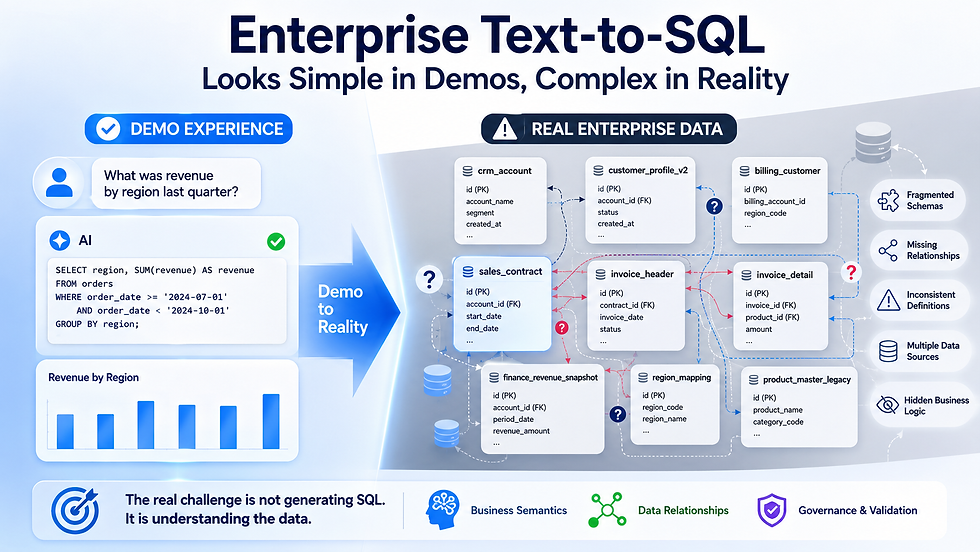
In a simple demo, the answer may be obvious. The database is small. Table names are clean. Relationships are clear. Metrics have one definition. The right query path is usually implied by the sample schema.
In a real enterprise, none of that is guaranteed.
A single business question may involve multiple source systems, inconsistent naming conventions, incomplete foreign keys, different versions of customer or product entities, historical and current dimensions, permission boundaries, and business metrics that vary by department.
In that environment, reliable Text-to-SQL is not only a language problem.
It is a context problem.
The AI does not just need a prompt.It needs query context.
SQL Generation Is Not the Starting Point
A common mistake in enterprise Text-to-SQL design is treating SQL generation as the center of the system.
The user asks a question.The model reads the schema.The model writes SQL.The system executes the query.
This workflow can work in controlled environments. But in enterprise settings, it often produces SQL that looks correct while answering the wrong question.
The query may use the wrong table.
It may join data at the wrong grain.
It may select a field with a similar name but a different business meaning.
It may use a direct join path that technically works but causes duplicate rows.
It may ignore permission rules or use a dataset that is not approved for that business scenario.
It may calculate a metric that looks familiar but does not match the company’s governed definition.
The SQL can be syntactically valid and still be analytically wrong.
That is why enterprise AI analytics needs to shift from a SQL-first workflow to a context-first workflow.
Before generating SQL, the system must understand:
what the user is asking
which business concepts are involved
which metrics and dimensions are trusted
which tables and fields represent those concepts
how those tables connect
which join path is appropriate
what permission rules apply
how the result should be validated
This structured understanding is what we call query context.
What Is Query Context?
Query context is the structured set of business, technical, relational, governance, and validation signals that an AI system needs before generating SQL.
It is not just schema information.
A database schema can tell the model that a table exists. It may show column names, data types, and sometimes foreign keys. But enterprise questions require more than that.
Query context answers deeper questions:
What does the business term mean?
Which metric definition should be used?
Which table is authoritative for this question?
What does one row represent in each table?
Which tables can be joined safely?
Which join path is trusted?
Which path may create duplication or data loss?
Which filters are implied by the business question?
Which data is the user allowed to access?
How should the generated SQL be checked before execution?
A reliable enterprise Text-to-SQL system does not simply ask the model to “write a query.”
It first builds the context required to make the query trustworthy.
Why Schema-Only Prompting Breaks in Enterprises
Many early Text-to-SQL systems rely heavily on schema prompting.
They provide the model with table names, column names, data types, and sometimes sample values. Then they ask the model to generate SQL.
This approach can be useful, but it has a clear limitation.
Schema is not meaning.
A column called customer_id may appear in several tables. Some may represent registered users. Some may represent billing accounts. Some may represent buyers. Some may represent legacy customer records migrated from another system.
A field called amount may refer to order amount, paid amount, invoice amount, refund amount, tax-inclusive amount, or recognized revenue.
A table called orders may include test orders, canceled orders, internal orders, marketplace orders, or only a subset of business channels.
The schema may show what exists, but it does not always show what should be trusted.
Even when the correct tables are identified, the relationships between them may not be fully declared in the database. Many enterprise systems do not maintain complete foreign keys. Some relationships exist only in ETL logic, BI models, data engineer documentation, or the memory of experienced analysts.
This is where schema-only prompting becomes fragile.
The model may infer relationships from column names. Sometimes it guesses correctly. Sometimes it produces a plausible join that creates a misleading result.
For enterprise analytics, plausible is not enough.
The system needs governed context before SQL generation.

The Five Layers of Query Context
A strong enterprise Text-to-SQL workflow needs at least five layers of query context.

1. Business Intent Context
The first layer is understanding the user’s business intent.
A user may ask:
“Show monthly revenue by active customer segment for the last quarter.”
This sounds simple, but it contains several business decisions.
What counts as revenue?What does active customer mean?Which customer segmentation model should be used?Should the result be based on order date, payment date, invoice date, or revenue recognition date?Should refunded orders be excluded?Should internal transactions be removed?Which business unit or region is implied?
Business intent context translates natural language into structured analytical intent.
It identifies the metric, dimension, entity, time range, filters, and expected output.
Without this layer, the AI may generate a query too quickly and miss the actual business meaning behind the question.
2. Semantic Context
The second layer is semantic context.
Semantic context defines business meaning.
It helps the system understand terms such as:
revenue
active customer
gross margin
churn
conversion rate
member user
qualified lead
recurring revenue
operating cost
A semantic layer can define approved metrics, dimensions, business terms, calculation logic, ownership, and usage rules.
This is essential because enterprise metrics often have multiple informal versions.
Sales may define revenue one way.Finance may define it another way.Operations may use a different operational version for daily monitoring.
If AI does not know which definition is trusted for the user’s question, it may generate SQL that appears correct but conflicts with business governance.
Semantic context gives the AI a governed business vocabulary.
But semantic context alone is not enough.
After the system understands what the business means, it still has to know how the data connects.
3. Relationship Context
The third layer is relationship context.
Relationship context explains how tables, fields, and entities connect across enterprise data.
It helps answer questions such as:
Which physical tables represent the required business entities?
Which fields can be used to connect those tables?
Is the relationship one-to-one, one-to-many, or many-to-many?
Is the join path direct or does it require bridge tables?
Is this relationship declared by foreign keys, inferred from data, or defined by governance?
Which join path is preferred for this analytical scenario?
Which join path may cause duplication or incorrect aggregation?
This layer is especially important because real enterprise data relationships are often incomplete, implicit, or distributed across systems.
A CRM system may store customer profiles.An ERP system may store invoices.An order system may store transactions.A membership system may store user tiers.A finance system may store recognized revenue.
The AI cannot reliably answer cross-domain business questions unless it knows how these data assets connect.
Relationship context turns disconnected schemas into usable analytical paths.
4. Governance and Permission Context
The fourth layer is governance context.
Enterprise AI analytics must respect permission boundaries, data ownership, and approved usage rules.
A user may ask a valid business question, but not every dataset should be available to every user.
Some fields may contain sensitive customer information.Some tables may be restricted to finance teams.Some metrics may only be approved for specific reports.Some datasets may be deprecated but still visible in the warehouse.
A reliable Text-to-SQL system needs to know:
which data the user can access
which fields are sensitive
which tables are approved for analysis
which metric definitions are governed
which datasets should not be used
whether the query should be blocked, rewritten, or clarified
Without governance context, AI-generated SQL may create security, compliance, or trust problems.
In enterprise environments, the safest query is not always the query that retrieves the most data.
It is the query that uses the right data under the right rules.
5. Validation Context
The fifth layer is validation context.
Even after the AI generates SQL, the system should not blindly trust it.
Validation context helps check whether the query is reasonable before or after execution.
It may include:
grain checks
join duplication checks
row count expectations
null rate checks
metric range checks
historical comparison
aggregation consistency
table freshness
known business constraints
explanation of assumptions
For example, if a query joins orders to order items and then calculates revenue at the customer level, the system should check whether the join changes the expected grain.
If a metric result is suddenly ten times higher than the previous month, the system should identify whether the issue comes from real business change, duplicated joins, missing filters, or incorrect table selection.
Validation context helps prevent the most dangerous kind of AI analytics failure:
a confident answer based on a flawed query.
A Simple Example: Monthly Revenue by Customer Segment
Consider the question:
“Show monthly revenue by active customer segment for the last quarter.”
A schema-only Text-to-SQL system may search for tables that look relevant:
orders
customers
customer_segments
payments
Then it may generate a SQL query based on column names.
But a context-aware system would ask a deeper set of questions before generating SQL.
First, it identifies the business intent.
The user wants a monthly trend, grouped by customer segment, using revenue as the metric and active customer segment as the dimension.
Then it checks semantic context.
What is the approved revenue definition?Should revenue be based on paid orders, invoiced amount, or recognized revenue?Should refunds be deducted?Should canceled orders be excluded?
Then it checks relationship context.
Which customer table should be used?Is customer segment stored in the current customer profile table or a historical segment table?Should the segment be based on the current segment or the segment at the time of purchase?How do orders connect to customers?Is there a bridge table between account, user, and billing customer?
Then it checks governance context.
Is the user allowed to access revenue data?Is customer segmentation data restricted?Is this dataset approved for business reporting?
Then it checks validation context.
Does the join duplicate orders?Does the monthly total match the approved revenue baseline?Are there missing segment values?Is the result consistent with known reporting logic?
Only after these steps should the system generate SQL.
This is the difference between SQL generation and trusted query generation.
From Prompting to Query Planning
Enterprise Text-to-SQL should not be viewed as a single model call.
It should be viewed as a query planning process.
A more reliable workflow looks like this:
The user asks a natural language question.
The system identifies business intent, metrics, dimensions, filters, and time range.
The system retrieves semantic context for business definitions.
The system retrieves relationship context for tables, fields, and trusted join paths.
The system applies governance and permission rules.
The system builds a query plan.
The system generates SQL based on that plan.
The system validates the SQL and expected result.
The system explains the answer, including assumptions and data sources.
This workflow is more complex than simple prompting, but it is closer to how enterprise analysts actually work.
Experienced analysts do not start by writing SQL immediately.
They first clarify the metric.They check the grain.They choose the right source table.They confirm the join path.They apply business filters.They compare the result with known numbers.
Enterprise AI needs a similar discipline.
The goal is not to make the model write SQL faster.
The goal is to make the system produce answers that the business can trust.

Why Trusted Join Paths Matter
Among all layers of query context, trusted join paths are especially important.
A join path is the route the query uses to connect tables.
In simple systems, this may be obvious.
In enterprise data environments, it rarely is.
There may be multiple ways to connect customer, order, invoice, product, contract, and finance data. Some paths may be technically valid but analytically wrong.
A direct join may ignore a bridge table.A many-to-many relationship may inflate totals.A current dimension may overwrite historical context.A legacy ID may connect only part of the dataset.A field name may match across tables but represent a different business entity.
The model may not know these risks from schema alone.
Trusted join paths give the AI a safer foundation.
They tell the system not only which tables can connect, but which connection should be used for a specific business scenario.
This is where relationship discovery becomes more than a data engineering task.
It becomes part of the AI reasoning infrastructure for enterprise analytics.
Where Arisyn-Semora and Arisyn-IntaLink Fit
In the Arisyn platform, query context is built from two complementary foundations.
Arisyn-Semora focuses on semantic intelligence.
It helps organize business metrics, dimensions, terms, governed definitions, query intent, SQL generation, validation, and explanation.
Its role is to help AI understand what the business question means and how the answer should be governed.
Arisyn-IntaLink focuses on data relationship intelligence.
It helps discover table relationships, field relationships, entity connections, relationship strength, and trusted join paths across enterprise data.
Its role is to help AI understand how the data connects before SQL is generated.
Together, Semora and IntaLink help transform enterprise structured data from a collection of schemas into a more query-ready context layer for AI analytics.
This does not replace the need for data warehouses, BI tools, catalogs, or semantic layers.
Instead, it strengthens the context that AI systems need to work reliably with enterprise data.
What This Means for Enterprise AI Analytics
The next stage of enterprise AI analytics will not be won by SQL generation alone.
Models will continue to improve.SQL generation will become faster and more fluent.More systems will support natural language interfaces.
But enterprises will still face the same underlying problem:
AI cannot reliably query data it does not understand.
If the business meaning is unclear, the answer will be unstable.
If table relationships are unknown, the join path will be risky.
If permissions are ignored, the workflow will not be enterprise-ready.
If validation is missing, wrong answers will look convincing.
The real foundation for enterprise AI analytics is not just a better prompt.
It is governed, structured, reusable query context.
That context should include business semantics, metadata, table relationships, trusted join paths, permission rules, and validation signals.
Only then can natural language become a reliable interface for enterprise data.
Conclusion
Enterprise Text-to-SQL is often described as a translation problem.
A user asks a question in natural language.The AI translates it into SQL.
But in real enterprise environments, the challenge is deeper.
The AI must understand business meaning.It must know which data is trustworthy.It must understand how tables connect.It must respect governance rules.It must validate the query before presenting the answer.
That is why query context matters.
Reliable enterprise Text-to-SQL does not start with SQL generation.
It starts with the context behind the query.
When AI has access to governed semantic context and trusted relationship context, it can move beyond plausible SQL and toward trusted enterprise answers.


Comments