


Why AI Needs Join Intelligence


For years, discussions about AI-powered analytics have focused on one goal:
Can AI generate SQL from natural language?
The industry has made remarkable progress.
Modern language models can translate business questions into syntactically correct SQL with impressive accuracy.
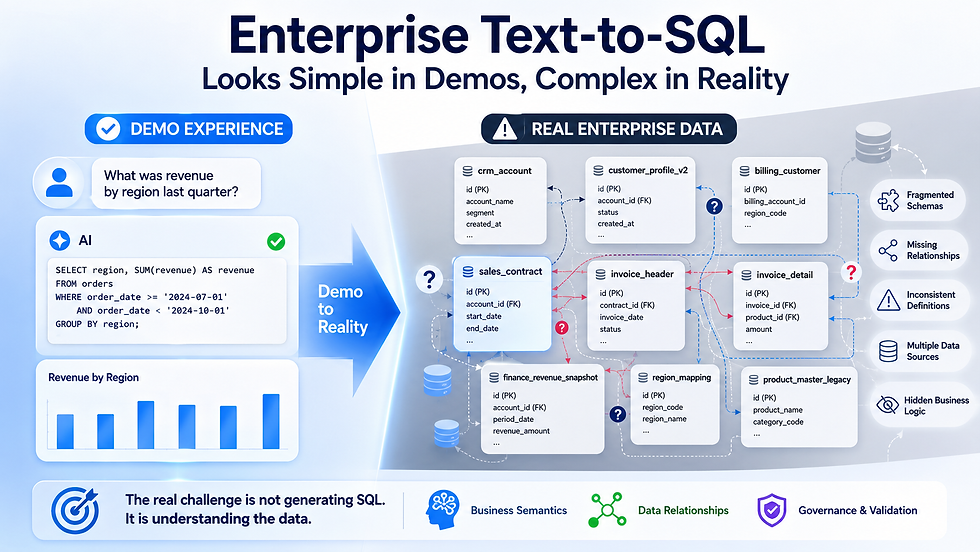
Yet many enterprise AI projects still struggle when they move beyond demonstrations and into production environments.
The reason is surprisingly simple.
Writing SQL is not the hardest part of analytics.
Choosing the right joins is.
SQL Is Easy. Joins Are Hard.
Consider a simple business request:
Show quarterly revenue by customer segment.
Most AI systems can quickly identify:
Revenue
Customer
Segment
Quarter
Generating SQL syntax is rarely the problem.
The challenge begins when the AI must answer questions such as:
Which customer table should be used?
Which revenue source is authoritative?
Which relationship path is trusted?
Which join introduces duplication?
Which join reflects current business logic?
In modern enterprises, there is rarely only one answer.
Multiple paths often exist.
And not all paths produce the same result.
Why Experienced Data Engineers Rarely Start With SQL
Ask a senior analytics engineer how they solve a complex reporting problem.
They rarely begin by writing a query.
Instead, they start by understanding relationships.
Questions typically include:
How are these entities connected?
Which system owns the data?
Which tables are historical?
Which joins have been validated?
Which paths are currently used in production?
Only after those questions are answered does SQL become useful.
In many organizations, this knowledge exists only in the minds of experienced engineers.
Unfortunately, AI cannot inherit tribal knowledge.
The Missing Capability: Join Intelligence
Most Text-to-SQL architectures focus on:
Question
   ↓
LLM
   ↓
SQL
But enterprise analytics requires an additional step:
Question
      ↓
Business Context
      ↓
Relationship Discovery
      ↓
Join Intelligence
      ↓
SQL Generation
      ↓
Validation
Join intelligence is the ability to understand:
Which relationships exist
Which relationships are trusted
Which join paths are valid
Which joins should be avoided
Which joins align with business definitions
Without this capability, AI is forced to guess.
And analytics should never be based on guesses.
Why Better Models Don't Solve the Problem
Many organizations assume larger models will eventually eliminate these issues.
But this is not fundamentally a reasoning problem.
It is a context problem.
Even the most advanced model cannot reliably choose a trusted join path if that information is not available.
Imagine asking a model:
Join customer, order, subscription, invoice, and product data.
The model may generate a perfectly valid query.
Yet it still has no way to know:
Which customer identifier is authoritative
Which historical mappings should be excluded
Which relationship has been deprecated
Which business-approved path should be used
The missing information does not exist inside the model.
It exists inside the enterprise.
The Rise of Join-Aware AI Analytics
As enterprise AI matures, a new requirement is emerging.
AI systems must become join-aware.
This means moving beyond schema awareness and semantic understanding.
The system must also understand connectivity.
A join-aware architecture can:
Discover relationship paths automatically
Recommend trusted joins
Validate join quality
Reduce duplication errors
Improve query consistency
Support more reliable AI-generated analytics
In other words, the goal is not simply generating SQL.
The goal is generating trusted SQL.
Why This Matters for the Future of Enterprise AI
The future of enterprise analytics will not be defined by who has the largest model.
It will be defined by who has the best context.
Semantic context helps AI understand business meaning.
Relationship context helps AI understand data connectivity.
Join intelligence transforms that knowledge into reliable analytical outcomes.
As organizations continue investing in AI-driven analytics, join intelligence may become one of the most important capabilities in the modern data stack.
Because in enterprise analytics, the challenge was never writing SQL.
The challenge was knowing how the data should be connected.
And that is exactly what AI still needs to learn.


Comments