


From AI That Answers Questions to AI That Makes Decisions: Why Enterprise Data Needs a Decision Context Layer


Introduction
Over the past year, enterprise AI has made remarkable progress.
Large language models can generate SQL, summarize reports, write code, and even perform multi-step reasoning. These capabilities have dramatically lowered the barrier to accessing enterprise data.
Yet many organizations still hesitate to let AI participate in important business decisions.
The reason isn't that AI can't answer questions.
It's that answering a question and supporting a business decision are fundamentally different problems.
A dashboard can tell you what happened.
A decision requires confidence that the answer is based on trusted business logic.
That confidence doesn't come from the language model itself.
It comes from the context surrounding enterprise data.
---
The First Generation of Enterprise AI
Most enterprise AI applications today are designed around a simple workflow.
```
Question
↓
LLM
↓
SQL
↓
Answer
```
For example:
> Which region generated the highest revenue last month?
The AI converts the question into SQL.
The database returns the result.
The answer is displayed.
For many reporting scenarios, this works surprisingly well.
But real business decisions rarely stop there.
---
Decisions Require More Than Data
Imagine a sales director asking:
> Which customers should we prioritize next quarter?
That question isn't simply asking for data.
It requires understanding:
- Which customers are strategically important.
- Which revenue metric finance recognizes.
- Which contracts are still active.
- Which historical adjustments should be excluded.
- Which accounts belong to the same enterprise group.
- Which opportunities are already owned by another team.
Notice something interesting.
None of these questions are about SQL.
They're about business context.
---
Why Organizations Still Double-Check AI
One pattern appears repeatedly across enterprise AI projects.
The AI produces an answer.
Then someone opens Excel.
Someone checks the BI dashboard.
Someone asks Finance.
Someone messages an experienced analyst.
Eventually a human decides whether the answer can be trusted.
The language model isn't replacing this process.
It's simply becoming another participant in it.
That isn't necessarily a failure.
It's a sign that enterprise trust is built differently from consumer AI.
---
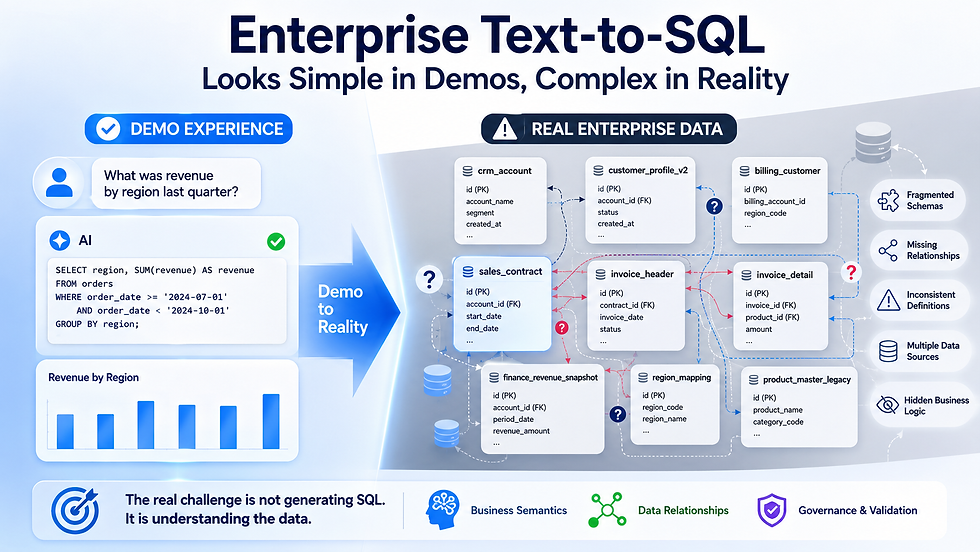
Enterprise Knowledge Lives Outside the Database
Many organizations assume that once data is centralized in a warehouse, AI has everything it needs.
In reality, some of the most important knowledge never reaches the warehouse.
Examples include:
- The metric executives use during quarterly reviews.
- The preferred customer hierarchy after acquisitions.
- Temporary reporting rules during system migrations.
- Approved join paths between operational systems.
- Business exceptions that everyone follows but nobody documents.
Experienced employees know these rules naturally.
AI doesn't.
Without them, every answer carries uncertainty.
---
The Next Layer: Decision Context
Most discussions focus on three kinds of context.
**Data Context**
Where is the data stored?
**Semantic Context**
What does each business term mean?
**Relationship Context**
How are datasets connected?
These layers are essential.
But enterprise AI increasingly needs another one.
**Decision Context.**
Decision Context captures the rules organizations actually use when turning data into action.
It includes:
- Approved metrics
- Governance policies
- Business priorities
- Organizational constraints
- Decision history
- Confidence levels
- Exception handling
Instead of simply helping AI answer questions, it helps AI explain why one recommendation should be trusted over another.
---
Why This Matters for AI Agents
The rise of AI agents changes the problem again.
Agents don't just retrieve information.
They plan.
Reason.
Coordinate.
Take actions.
As organizations begin deploying multiple AI agents across finance, operations, sales, and customer service, consistency becomes critical.
If every agent understands business rules differently, organizations won't trust automation.
Shared decision context creates a common foundation.
Different AI agents can reason independently while following the same business principles.
---
Enterprise AI Is Becoming Infrastructure
Five years ago, enterprise data teams focused on building better dashboards.
Today they're building better AI assistants.
The next stage may be even more important.
Building infrastructure that allows every AI application to reason from the same trusted business context.
This isn't another model.
It isn't another prompt.
It's an organizational capability.
One that becomes more valuable every time a new AI application is introduced.
---
Looking Ahead
The conversation around enterprise AI often centers on model benchmarks.
Reasoning scores.
Context windows.
Latency.
Cost.
Those improvements matter.
But they won't determine which organizations build trusted AI.
The real differentiator will be how well companies organize the knowledge that surrounds their data.
Because in enterprise environments, decisions are rarely limited by information.
They're limited by confidence.
---
Final Thoughts
The first generation of enterprise AI helped people ask questions.
The next generation will help organizations make decisions.
That transition requires more than better models.
It requires better context.
Not just semantic context.
Not just relationship context.
But decision context—the shared business knowledge that transforms accurate answers into trusted decisions.
Organizations that invest in this layer today won't simply deploy more AI.
They'll build AI that people are willing to rely on when the decision actually matters.


Comments