


Your Best Data Engineer Knows Something AI Doesn’t


Most discussions about enterprise AI focus on data.
More data.
Better data.
Cleaner data.
Governed data.
But after speaking with data leaders across different industries, I’ve become convinced that data is often not the biggest problem.
The real problem is that enterprises know things that never make it into the data.
And surprisingly, the people who know those things are often not executives, architects, or consultants.
They’re the experienced data engineers.
The Query That Should Have Worked
A few months ago, I spoke with a data team that had invested heavily in modern analytics infrastructure.
Their warehouse was well organized.
Metadata was documented.
Business metrics were defined.
The semantic layer was in place.
An AI-powered analytics assistant was deployed internally.
Everything looked ready.
Then a business user asked a seemingly simple question:
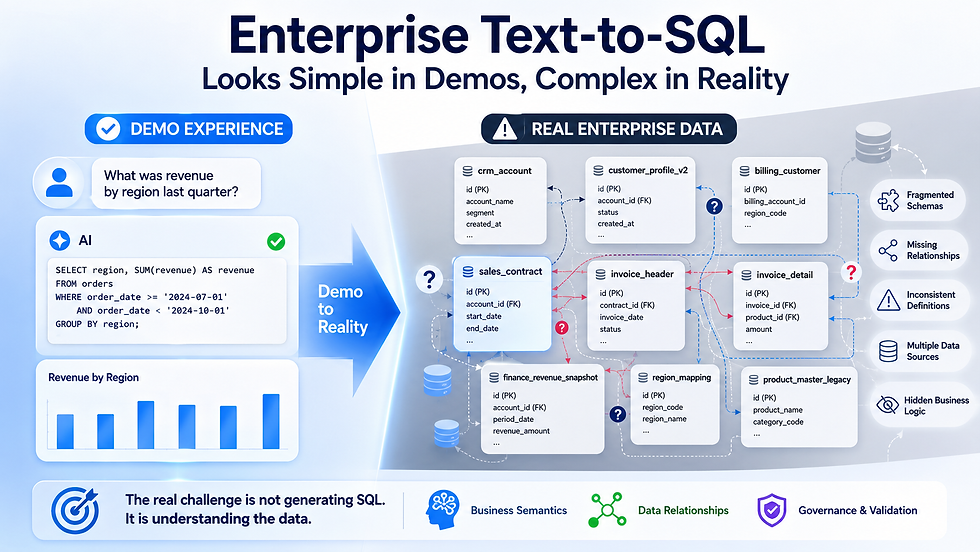
“Show me the top customers by revenue over the last six months.”
The AI generated valid SQL.
The query executed successfully.
The numbers were wrong.
Not slightly wrong.
Completely wrong.
The investigation eventually revealed the issue.
Revenue data was spread across multiple systems.
Several customer records represented the same organization.
One particular table contained historical adjustments that needed to be excluded.
None of these rules existed in metadata.
None existed in documentation.
The only reason the company knew about them was because a senior data engineer had learned them over years of supporting reporting processes.
The AI never had access to that knowledge.
The Hidden Layer Inside Every Enterprise
Most organizations think they have three layers:
Data.
Metadata.
Business definitions.
In reality, there is a fourth layer.
Knowledge.
This knowledge often exists in unexpected places:
· Slack conversations
· Project documents
· Internal wikis
· Old migration notes
· Email threads
· Team memory
· Experienced engineers
These pieces of knowledge explain things that data alone cannot.
Why one table should be preferred over another.
Why a metric is calculated differently in finance versus operations.
Why a particular relationship exists.
Why a commonly used join path is actually dangerous.
The warehouse stores data.
The organization stores knowledge.
They are not the same thing.
Why AI Struggles Without Knowledge
Most enterprise AI systems are excellent at processing information that is explicitly available.
Tables.
Columns.
Schemas.
Metrics.
Documentation.
But organizations operate on thousands of decisions that were never formally documented.
AI cannot reason about information it cannot see.
As a result, many enterprise AI deployments encounter a strange problem.
The generated SQL is technically correct.
The answer is operationally wrong.
The gap between those two outcomes is often knowledge.
Knowledge Is More Valuable Than Data
Many companies spend years building data platforms.
Far fewer invest in preserving organizational knowledge.
Yet knowledge is often the more fragile asset.
Data usually survives employee turnover.
Knowledge often does not.
When an experienced engineer leaves, the organization rarely loses data.
It loses context.
It loses reasoning.
It loses historical decisions.
It loses understanding.
In many cases, the most important asset walking out the door is not access to systems.
It’s the invisible knowledge accumulated over years of solving business problems.
The Next Evolution of Enterprise Analytics
For years, the industry focused on building better data infrastructure.
Then attention shifted toward metadata.
More recently, semantic layers became a major focus.
The next frontier may be knowledge infrastructure.
Systems that can capture:
· Operational knowledge
· Business reasoning
· Historical decisions
· Trusted practices
· Organizational memory
Not as static documents.
But as searchable, usable context that can support both people and AI systems.
Because the future challenge is no longer helping AI access data.
The challenge is helping AI access understanding.
Final Thought
Data tells you what exists.
Metadata tells you what it means.
Relationships tell you how it connects.
Knowledge tells you how it is actually used.
The organizations that succeed with enterprise AI will not necessarily be the ones with the largest data platforms.
They will be the ones that successfully transform organizational knowledge into usable context.
Because your best data engineer knows something AI doesn’t.
At least for now.


Comments